


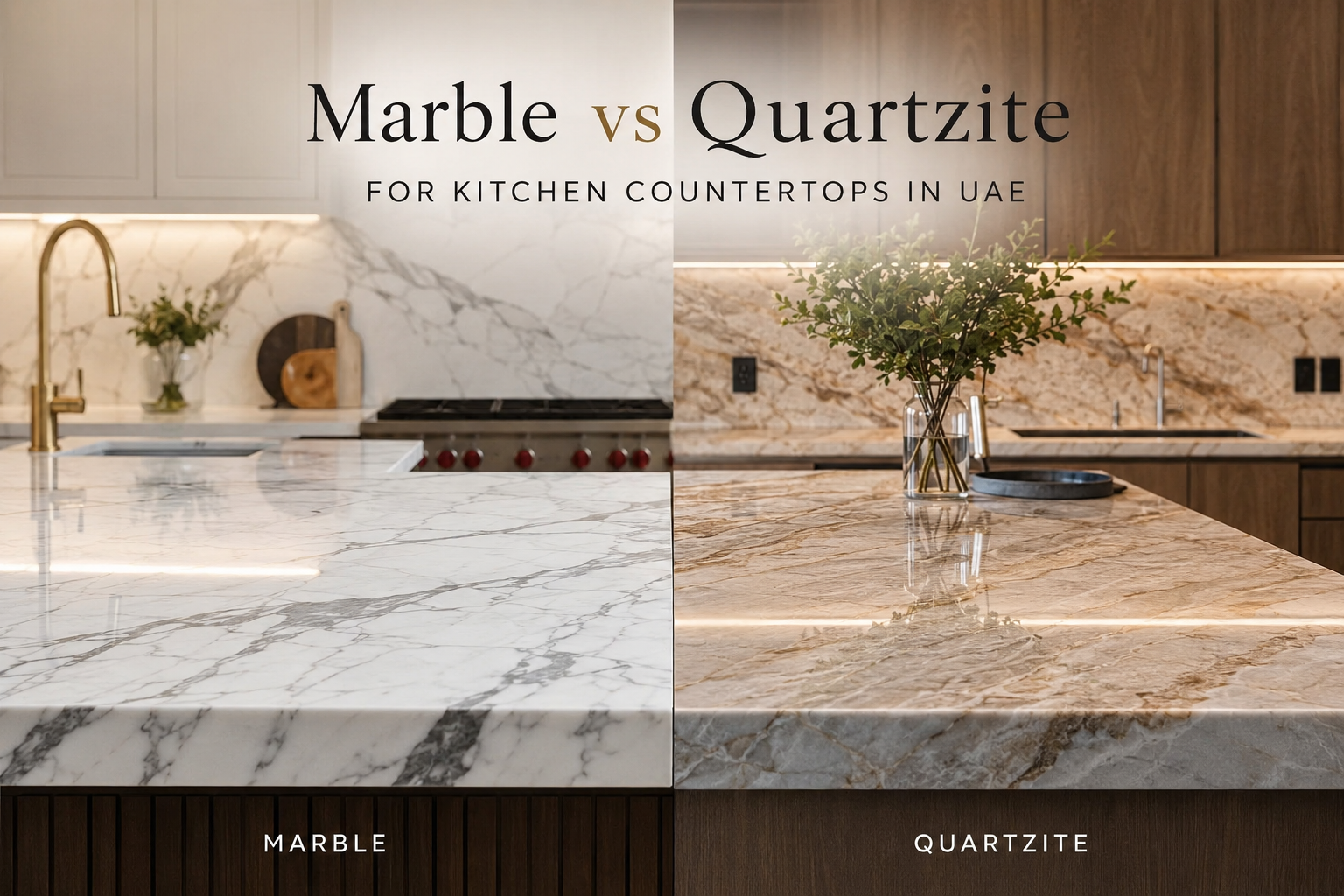
Choosing between marble vs quartzite for kitchen countertops in UAE homes requires more than comparing colours and patterns. Both are premium natural stones, but they perform differently under daily cooking, heat, food spills and regular cleaning.
Marble is prized for its depth, elegant veining and timeless architectural appeal. Genuine quartzite usually offers greater hardness and resistance to scratching, making it attractive for active family kitchens.
However, the right choice depends on the specific slab, finish, fabrication quality and how the kitchen will be used.
This guide compares marble and quartzite to help villa owners, architects, interior designers, developers and contractors choose the most suitable material for a luxury kitchen project.
Marble and quartzite are both natural stones formed through geological processes. Neither should be confused with engineered quartz, which is a manufactured surface containing mineral particles, resin and pigments.
Here is a simple comparison:
| Feature | Marble | Quartzite |
|---|---|---|
| Appearance | Elegant, soft and expressive veining | Marble-like movement with varied patterns |
| Hardness | Softer than quartzite | Generally harder and more scratch-resistant |
| Heat resistance | Naturally heat-resistant | Naturally heat-resistant |
| Acid sensitivity | Can etch from acidic foods | Usually less acid-sensitive, depending on the stone |
| Maintenance | Requires careful cleaning and sealing | Usually easier for active kitchens |
| Patina | Develops character over time | Often maintains its original finish longer |
| Best use | Statement kitchens and luxury interiors | High-use kitchens and large islands |
| Fabrication | Requires skilled handling | Requires powerful, precise equipment |
| Design appeal | Classic and timeless | Dramatic, durable and contemporary |
The comparison provides a general guide. Natural stones vary, so buyers should evaluate the actual slab rather than relying only on its commercial name.
Marble is a natural metamorphic stone known for elegant veining, soft colour movement and visual depth. It has been used in palaces, villas, hotels and landmark buildings for centuries.
Each marble slab is unique. Variations in veins, shades, mineral markings and background tones create a surface that cannot be perfectly duplicated by artificial materials.
Popular marble colours include:
Marble is often selected for luxury kitchen islands, feature splashbacks, breakfast counters and formal show kitchens.
Its beauty is also connected to its natural character. Small tonal variations, mineral marks and veins should not automatically be considered defects. They are part of the stone’s identity.
Quartzite is also a metamorphic natural stone. It begins as sandstone and changes under intense heat and pressure, creating a dense surface composed mainly of quartz minerals.
Genuine quartzite is usually harder than marble. This makes it attractive for kitchen countertops exposed to regular cooking, serving and cleaning.
Quartzite is available in many visual styles, including:
Some quartzite slabs closely resemble marble while offering greater resistance to everyday wear.
However, not every slab marketed as quartzite has identical geological properties. Buyers should work with a knowledgeable natural-stone supplier that can explain the material’s classification and expected performance.
For heavily used kitchens, genuine quartzite generally offers greater resistance to scratching and abrasion than marble.
This can make quartzite suitable for:
Marble is still a practical countertop material when the owner understands its maintenance requirements and accepts that the surface may develop a natural patina.
A formal show kitchen may place greater importance on visual impact. A working family kitchen may require stronger resistance to daily wear.
The decision should therefore reflect the client’s lifestyle, not only the appearance of the slab.
Both marble and quartzite are natural stones with good heat resistance. However, this does not mean extremely hot cookware should be placed directly on the countertop.
A sudden temperature change can affect the stone, sealer, resin-filled areas or the bond between the countertop and supporting materials.
For both surfaces, homeowners should use:
Quartzite may offer strong performance in an active kitchen, but careful use remains important. Premium stone should be treated as a long-term architectural surface rather than an indestructible workbench.
Quartzite is generally harder than marble and usually provides better scratch resistance.
Marble can be scratched by sharp or abrasive objects, especially when it has a highly polished finish. Fine marks may also become more visible on dark or reflective marble surfaces.
Recommended precautions include:
Quartzite is more resistant, but it is not completely scratch-proof. The exact performance depends on the individual slab and its geological composition.
Marble contains minerals that can react with acidic substances. Lemon juice, vinegar, tomatoes and some cleaning chemicals may leave dull marks known as etching.
Etching is different from staining.
A stain occurs when a substance penetrates the stone and changes its colour. Etching changes the surface finish and may create a lighter or duller patch.
Quartzite is generally less sensitive to food acids than marble. However, some commercially labelled quartzites may contain softer minerals or be geologically closer to marble.
Spills should therefore be cleaned quickly on both surfaces.
In UAE kitchens, common sources of staining or surface damage may include:
A quality sealer can reduce absorption, but it cannot completely prevent marble from etching.
The kitchen island is often the visual centre of a luxury interior. It may also be one of the hardest-working surfaces in the home.
Marble is suitable for a statement island when:
Quartzite may be preferable when:
For many UAE villa projects, designers use one material for the main worktops and another for the statement island. This allows the kitchen to balance practicality with dramatic visual impact.
Luxury is not determined by the stone category alone. It depends on slab quality, rarity, colour balance, vein movement, fabrication and how the material connects with the surrounding interior.
Marble often creates a classical and timeless look. It works well with:
Quartzite can create a sophisticated contemporary appearance. It pairs well with:
The most luxurious result usually comes from selecting full slabs with the right scale and movement for the room.
A beautiful sample does not always represent the full slab. Large veins, colour changes and mineral formations may only become visible when the complete surface is inspected.
The finish changes the appearance, texture and maintenance characteristics of both marble and quartzite.
A polished surface has a reflective appearance that enhances colour and veining.
It is suitable for:
Polished marble can make etching more visible because acidic substances affect the reflective finish.
A honed surface has a smooth, matte or satin appearance.
It can create a softer, more contemporary look and may make minor surface changes less noticeable than a high-gloss finish.
Honed stone may require careful sealing because some finishes can be more absorbent.
A leathered surface has a lightly textured appearance. It is particularly popular with darker granites and selected quartzites.
It can:
The best finish should be selected after viewing a physical sample, not only a digital photograph.
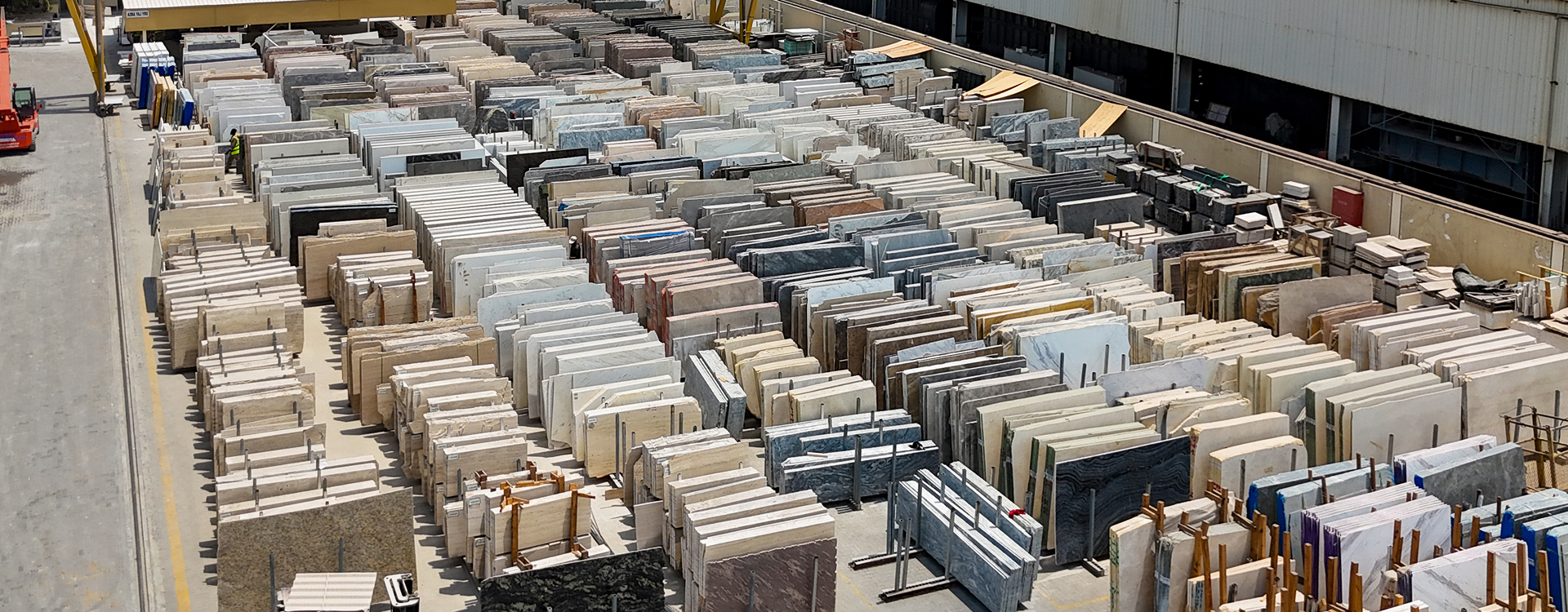
Natural-stone countertops should be selected from full slabs whenever possible.
Small samples cannot show:
For large kitchens, multiple slabs may be required. The selected slabs should be checked together to ensure acceptable colour and pattern continuity.
A professional selection process should include:
At Siom Marble’s Sharjah showrooms, buyers can compare natural-stone options and discuss how individual slabs may work within their kitchen design.
Bookmatching is a technique in which adjacent slabs are opened and arranged like pages of a book. This creates a mirrored pattern.
It is commonly used for:
Not every slab is suitable for bookmatching. The vein direction, slab sequence and available quantity must be evaluated before cutting.
Vein continuity is also important when a pattern needs to continue across:
Careful digital mapping and dry-lay approval can prevent disappointing pattern interruptions.
Even a rare and expensive slab can look poor when it is incorrectly fabricated.
Luxury countertop fabrication requires accurate:
CNC machinery can produce precise sink, hob and socket cut-outs. Waterjet systems can create detailed inlays and custom patterns. Skilled hand-finishing remains important for edges, joints and visible details.
Siom Marble operates its own factory with CNC, waterjet, finishing, bookmatching and custom-fabrication capabilities. This enables greater control over the process from slab selection to production and installation.
Planning a villa, hospitality or development project?
Send your kitchen drawings, BOQ or countertop dimensions to Siom Marble for material-selection and fabrication guidance.
Both marble and quartzite should be maintained using products suitable for natural stone.
Recommended daily care includes:
Sealing frequency varies. It depends on:
A simple rule such as “seal every year” may not suit every stone. The supplier or installer should recommend a maintenance schedule for the selected material.
Quartzite may be the better option for villa owners who want:
Marble may be more suitable for owners who want:
Neither material is automatically better for every homeowner.
A client who values perfection and expects the countertop to remain visually unchanged may prefer a durable quartzite.
A client who appreciates natural ageing, patina and architectural authenticity may prefer marble.
Design professionals should consider more than aesthetics when specifying either material.
Important questions include:
For large projects, early coordination between the designer, supplier, fabricator and contractor can reduce wastage, redesign and programme delays.
Interior designers and architects can request slab images, finish samples and technical guidance from Siom Marble for material boards and client presentations.
A sample cannot communicate the full movement of a natural-stone slab.
Commercial stone names are not always reliable indicators of geology or performance.
A surface suitable for a show kitchen may not suit an active family kitchen.
Poorly placed cuts can destroy the strongest visual part of the slab.
Sealing helps reduce absorption but does not make stone stain-proof or etch-proof.
Communication gaps between the supplier, fabricator, kitchen contractor and installer can create measurement and installation problems.
A lower price may exclude important services such as slab reservation, digital templating, dry laying, edge finishing, delivery or installation.
Before approving marble or quartzite, ask:
Clear answers help buyers compare suppliers on quality and service, not only price.
When comparing marble vs quartzite for kitchen countertops in the UAE, the best choice depends on lifestyle, design expectations and maintenance preferences.
Marble offers timeless beauty, natural depth and exceptional artistic character. It is ideal for statement kitchens where the owner appreciates natural patina and is prepared to care for the surface.
Genuine quartzite usually provides greater hardness and resistance, making it well suited to active kitchens, family villas and heavily used islands.
The final decision should be made after inspecting full slabs, confirming the material type, reviewing the finish and planning the fabrication details.
Siom Marble supplies premium natural stones sourced from around the world and supports clients through slab selection, custom fabrication, finishing, bookmatching and installation.
Visit one of Siom Marble’s Sharjah showrooms or submit your kitchen drawings to explore suitable marble and quartzite options for your project.